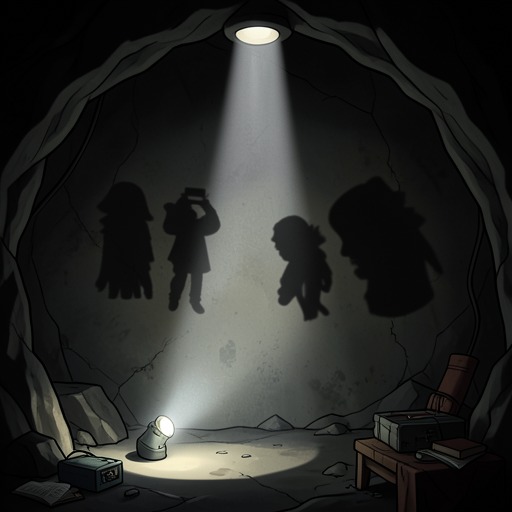
Exploration 4 Disaster
House of LeavesExploration #4 is the expedition into the Spiral Staircase that converts methodical exploration into catastrophe. Planned as a four- or five-night descent beyond the limits of reliable communication, it begins with equipment, weapons, rationing, and contingency plans, then turns on a chain of environmental impossibilities and human decisions: distances appear to stretch, caches are destroyed, a growl becomes the sign of a creature, and Holloway Roberts abandons the expedition's shared objective in pursuit of prey. The gunshot that wounds Kirby “Wax” Hook crystallizes the disaster, leaving Jed Leeder to carry the injured man while Holloway vanishes into the blackness.
Causes and Preparation
Holloway's preparation is presented against domestic tensions that might have distracted a less focused expedition leader, but he refuses to let those stresses interfere with the work ahead. The scale of the undertaking already exceeds ordinary caving practice. Spending one night in an enclosed, lightless place is uncommon; even the Lechugilla Crystal Cavern generally requires visits of only twenty-four to thirty-six hours. Holloway expects the team to remain in the Spiral Staircase for at least four, possibly five nights, making the expedition a sustained logistical operation rather than a brief reconnaissance.
The preparations also reveal a growing awareness that ordinary exploratory language may be inadequate. Leon Robbins suggests that “Operation” would be a more appropriate term than “Exploration,” a distinction that anticipates the expedition's increasingly militarized character. Holloway brings a rifle for the first time, unlike Explorations #1 through #3. When Will Navidson asks what he intends to shoot, Holloway answers, “Just in case.” The weapon therefore enters the expedition under the sign of contingency, but its presence also establishes a latent possibility of violence before the team knows what, if anything, is waiting below.
Communication is treated as another unavoidable limit. During Exploration #3, the team had discovered how quickly transmissions deteriorated, while installing thousands of feet of audio cable would be impractical. Holloway resolves the problem by accepting the loss of radio contact after the first night and telling the others that they will be on their own for four to five days. The plan is austere but explicit: once the team passes beyond communication, survival will depend on preparation, mutual discipline, and the markers and supplies placed along the route.
Descent, Delay, and Environmental Change
The return journey becomes the first major reversal. After reaching the bottom of the Spiral Staircase, Holloway's team begins the long trek back and discovers that the stairs are much farther away than anticipated, as if the distances have stretched during their absence. The delay forces a fourth night of camping and strict rationing of food, water, and batteries. On the morning of the fifth day, they finally reach the stairs and begin climbing. Although the ascent proceeds quickly, the staircase's diameter has grown to more than seven hundred and fifty feet, turning an already immense structure into something still less measurable and less governable.
The route back is also being erased or violated. Holloway finds one of the team's foot-long neon markers barely attached to the wall, its fabric badly torn as though mauled by an unimaginable claw. The next cache has been gutted: only traces of the plastic water jug and scattered pieces of PowerBars remain, while the fuel for the campfire stove has disappeared completely. These losses are not merely inconveniences. They undermine the system by which the expedition has tried to impose continuity on the labyrinth, converting the team's planned return into a passage through depleted resources and uncertain signs.
The missing supplies make the expedition part of a broader pattern in which hostile environments exceed human planning. Historical comparisons elsewhere in the narrative place exploration beside the dangers of the Magellan expedition, Henry Hudson's Fourth Voyage, and the Jamestown Colony, where cold, starvation, disease, and isolation transform geographic projects into ordeals. Exploration #4 intensifies that pattern in an impossible architectural setting: the danger is not only physical hardship but an environment whose distances, routes, and traces appear capable of changing without warning.
The Growl and Holloway's Reorientation
Holloway responds to the damaged marker and lost provisions less as an analyst than as a hunter. He takes out a Weatherby 300 magnum, checks the bolt and scope mounts, loads five 180 grain Nosier Partition rounds, and chambers a sixth. The act gives him a moment of apparent satisfaction, as though the weapon has supplied the place with a form he can understand. The growl, previously something that might have been treated as a quality or acoustic property of the environment, becomes for Holloway the utterance of a definite creature.
That interpretation changes his objective. He rushes after the sound, often without resting and without laying fishing line or hanging neon markers. The expedition's original goal had been to reach the bottom of the staircase, and Holloway had achieved it. He now treats the hunt as a new goal, making the earlier mission subordinate to the pursuit of an elusive presence. The word “abort” becomes significant because it frames withdrawal as failure: the prey has not been killed, and the newly imagined objective has not been completed.
Jed Leeder and Wax recognize the danger in this redefinition. To begin hunting an unseen presence at this stage is, in their judgment, equivalent to suicide, so they turn back toward the stairs. Their decision preserves the expedition's original survival logic, while Holloway's choice replaces collective return with solitary pursuit. The contrast is crucial: the disaster emerges not from a single external threat alone but from competing interpretations of what the expedition has become.
The Shooting and Abandonment
When Holloway fails to return, Jed and Wax wait on the staircase for several hours before making a brief search. They call his name and try to locate and bring him back, but find neither Holloway nor any neon marker or shred of fishing line. He has run off blind, severing himself from the navigational system that might have made a return possible. The darkness is therefore not just a setting; it becomes the condition under which responsibility, orientation, and shared knowledge can all be lost.
An hour later, Jed and Wax reach another cache, placed out of the way against the wall near the entrance to an unexplored corridor. The food and fuel are gone, but the water jug remains intact. Wax takes a second drink, and the scene turns violently without warning: a rifle cracks, and he falls with blood gushing from his left armpit. The wound converts uncertainty into immediate bodily crisis. Wax cries out for help, and Jed crouches beside him to apply pressure while Holloway emerges from the dark corridor with the rifle in hand.
Holloway appears shocked by both the sight of the two men and the sight of the stairs. His shock does not restore cooperation. Instead, he shouts, “Are you crazy?” and declares, “I can’t go back now. I just shot someone.” The statement exposes the self-perpetuating logic of his decision: because he has fired at a human companion, returning would force him to confront the act, while remaining in the darkness allows the hunt and its consequences to continue.
Holloway struggles to his feet but does not help Jed. He walks away and disappears again behind the impenetrable curtain of blackness, leaving Jed to carry and care for Wax alone. Departure becomes his only choice, not because the expedition has achieved a rational objective but because the social consequences of his action have become intolerable to him. The resulting abandonment is the expedition's ethical rupture: the team entered the Spiral Staircase as a coordinated unit, but the crisis leaves one member wounded, one member responsible for rescue, and the leader choosing disappearance over repair.
Consequences and Significance
Wax attempts to remain brave before the camera, forcing a smile despite his pallor. His request for water is especially disturbing because he has swallowed a large gulp only moments earlier; thirst has become an expression of physiological and psychological breakdown rather than a simple shortage. Meanwhile, Holloway's cries become so extreme that he is described as no longer a man but a creature stirred by fear, pain, and rage. The expedition reverses its categories: the team searches for a creature in the darkness, while Holloway himself increasingly occupies the place of the transformed and threatening being.
The disaster also gives the growl a structural role. Its source remains uncertain, but its effect is concrete. It reorganizes Holloway's perception, turns damaged equipment into evidence of pursuit, and authorizes the use of a weapon. In this sense, the unseen threat is more powerful than a fully revealed monster would be: it operates through anticipation, inference, and the human need to convert an incomprehensible environment into an opponent that can be tracked and killed.
The expedition's physical stakes remain severe even after the gunshot. The shortages of food, water, fuel, and batteries compound the danger of isolation, while the altered scale of the Spiral Staircase destroys confidence in distance and return. The contrast with ordinary exploration is therefore decisive. A journey that should have ended with the team climbing back toward safety instead becomes a descent into an environment where maps fail, communications end, supplies vanish, and the leader's identity as protector collapses under pressure.
Exploration #4 is consequently both an adventure plot and a failed return. Its quest structure is inverted: reaching the bottom does not complete the mission, and the road back does not restore the group. The expedition produces no stable knowledge of the growl or the space that contains it. What it reveals instead is the cost of pursuing certainty in a place that supplies only fragments—torn markers, emptied caches, an unexplained sound, and a wounded companion. The catastrophe lies in that mismatch between the desire for a final objective and an environment that continually withdraws the possibility of completion.